


In the 1970s Liverpool Free Press attended a conference of “alternative” newspapers from around Britain. One topic that cropped up was the law of libel and what to do if someone threatened to sue. It was clear from the discussion that most of the people attending knew very little about defamation or what to do if someone threatened to sue. If problems arose, one person suggested, the best thing to do was consult a solicitor.
Steve Scott, one of the Free Press journalists at the conference, objected to that. Involving solicitors was a bad idea, he said, because it meant playing by the rules of the legal game – rules that were heavily loaded against “alternative” papers. Instead, they should fight libel claims by alternative means.
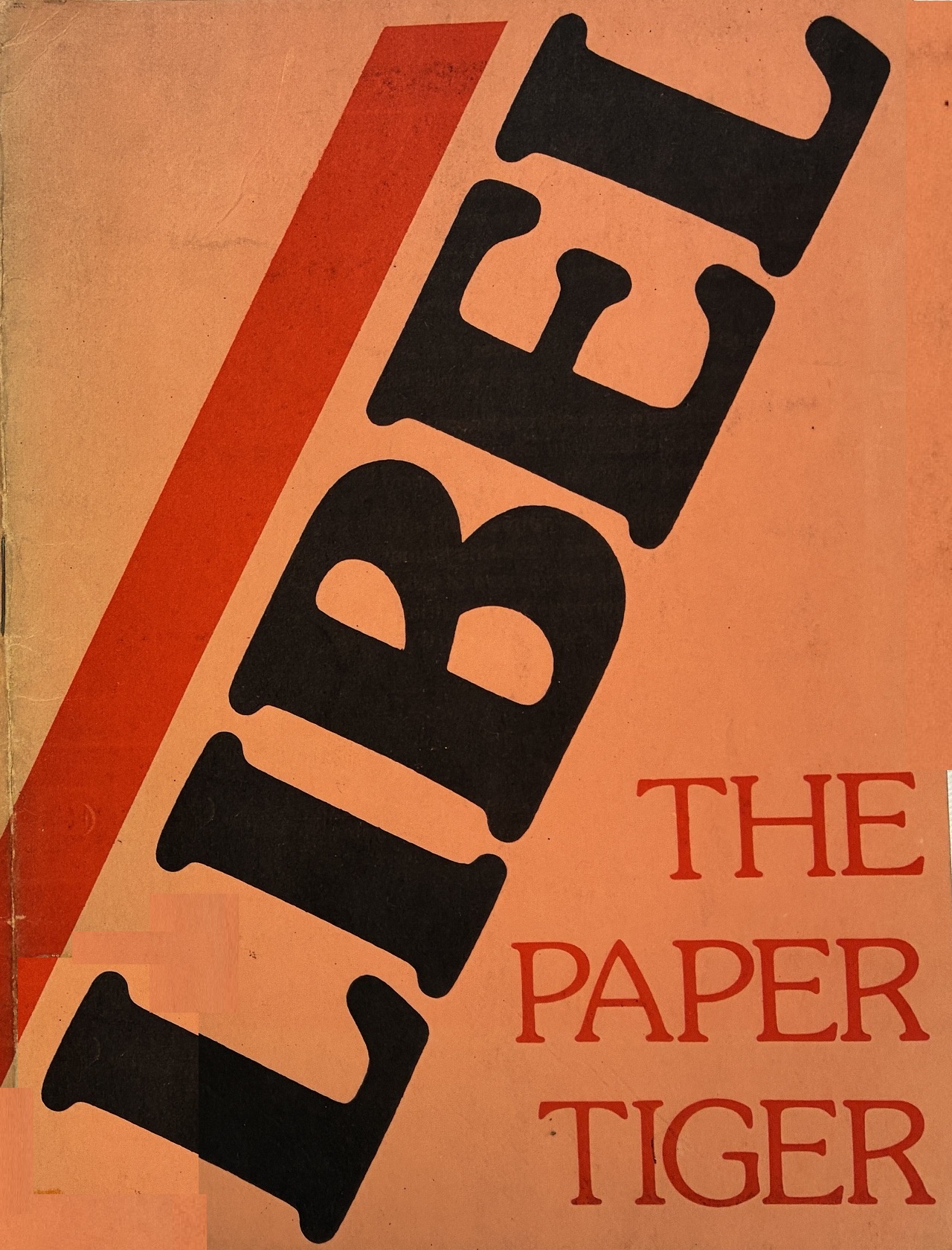
Steve – who had studied law at university – later elaborated on this idea in a pamphlet, “Libel: the paper tiger”, which offered some guidelines for “alternative” publishers.
The text of the pamphlet, scanned from the original and reproduced below, is in three sections. The first part, “The law on paper”, explains what defamation is, and how the law operates – information that in the mainstream media is an essential part of a journalist’s training.
The second section, “The law in reality”, is a critique of the law, mainly from a class perspective: “Libel protects only the rich,” he wrote, since the legal costs involved are prohibitive for the average person.
The last – and most interesting – section, headed “Publish and damn them”, proposes a series of “evading tactics” (partly based on experience at the Free Press) which it recommends as a more effective way for “alternative” newspapers to fend off libel claims ...
(a) WHAT IS DEFAMATION?
Defamation is the publication to a third person of matter "containing an untrue imputation against the reputation of another". (Gatley on Libel and Slander). The law protects one's "reputation".
Defamation falls into two categories: Libel and slander. Libel differs from slander in that defamatory material is published or communicated in a more or less permanent form, instead of being merely spoken. Defamatory statements in newspapers, magazines or letters are therefore libels, not slanders. Radio and television broadcasts are also regarded as libels. The importance of the distinction is that, with a few exceptions, a victim of slander must prove he has suffered loss before he can claim compensation through the courts by way of damages. In libel cases this proof is not necessary — damage is presumed.
We are concerned here with libel. To succeed in an action for libel the complainant must prove:
a) that the statement was defamatory;
b) that it referred to him;
c) that the defendant published it.
But the question What is a defamatory statement? is not easy to answer. It is important to realise that a true statement can still be libellous. (See the case of Lewis v. Daily Telegraph, below.)
The test laid down by Lord Atkin, a judge, in 1936 was: "Would the words tend to lower the plaintiff [complainant] in the estimation of right-thinking members of society generally?" This is not easy to apply in practice. The fact is that it is impossible to say whether certain statements are libellous or not. For example, is it libellous to say that a man is a Communist, or that someone is illegitimate, impotent, poverty-stricken, the daughter of a murderer, or a negro, or a strike-breaker. What would "right-thinking members of society" think?
According to Professor Harry Street (see The Law of Torts) the test seems to be: A defamatory statement is one which (a) would cause most people to shun or avoid a person; or (b) would result in a substantial and respectable(!) proportion of society thinking less well of a person, provided this reaction is not plainly anti-social or irrational.
Both statements of fact and opinions can be defamatory. In Liberace v. Daily Mirror (1959) Liberace was described as "The Summit of Sex — the pinnacle of masculine, feminine and neuter. Everything that He, She or It can ever want ... This deadly, winking, sniggering, snuggling, chromium-plated, scent-impregnated, luminous, quivering, giggling, fruit-flavoured, mincing, ice-covered heap of mother love." Liberace won because the jury decided this description implied homosexuality.
Even rather obvious satire can sometimes be dangerous as 'Socialist Worker' found to their cost when sued by ASTMS union official Clive Jenkins in 1977 (see below).
Common sense would make most journalists wary of some abuse. Not surprisingly, it has been decided in court that it may be defamatory to call a man a hypocrite, a villain, a black-sheep, an habitual drunkard or a pansy. But journalists might not be aware that they cannot call a man "a crook" even when he has a conviction or describe another journalist as "libellous" even though he has been sued successfully for libel. The law contends that such statements describe an habitual criminal or libellor, which cannot be justified by a single court case.
The answer here is to stick strictly to the known facts: "Mr X was lying when he said..." rather than "Mr X is a liar." Sweeping statements or vague generalisations are often more dangerous than specific statements.
In Lewis v. Daily Telegraph (1964) an article which stated that the Fraud Squad of the City of London Police were investigating the plaintiff's company was found defamatory. One of the judges, Lord Reid, said: "The sting is in inferences drawn from the fact that it is the Fraud Squad which is making the inquiry."
It made no difference that the story was true — there was such an investigation — or that the simple statement that the Fraud Squad was investigating was not inconsistent with the company's innocence. Apparently it was enough that the article implied there was a suspicion of guilt.
In Tolley v. Fry (1931) the defendant chocolate manufacturers had, without permission, published an advert showing Tolley, an amateur golfer, playing golf with a packet of Fry's chocolate sticking out of his pocket. This was held to be libellous because there was an innuendo that Tolley had prostituted his amateur status by agreeing to the advert for gain.
In Cassidy v. Daily Mirror (1929) the Mirror had, with Mr Cassidy's permission, published a photograph with the caption: "Mr Cassidy, the race-horse owner, and Miss X, whose engagement has been announced." Unknown to the Mirror, Cassidy was already married, and his wife successfully sued for libel because the article implied she had been "living in sin" with her husband. (However, under the Defamation Act 1952, "innocent libels", as in the Cassidy case, can be put right by an offer to publish a suitable correction and apology. See Legal Defences, page 5).
(b) THE MEANING OF WORDS
So far so good. But there are complications. When examining a newspaper article, the courts will normally give the words their ordinary and natural meaning. They will look at the whole article, so a careless phrase might be neutralised by other statements. However, the most important parts — like headlines — will be given extra weight.
Unfortunately, what the writer intended to mean is immaterial. The courts try to discover what the ordinary reader would take the words to mean. Words can, of course, have more than one meaning: They can contain what is known as an "innuendo". Some statements contain meanings far beyond the writer's imagination. For example, the false statement that Mr X advertises his professional services in a newspaper appears safe enough. But if Mr X is a barrister he would have been libelled by innuendo, because advertising is a breach of professional etiquette. Innuendoes figure prominently in libel actions.
(c) WHO CAN SUE?
Any living person can be defamed. So can a trading corporation (i.e. company), though in this case only a commercial, not a social reputation is protected. A statement "must attack the corporation or company in the method of conducting its affairs, must accuse it of fraud or mismanagement, or must attack its financial position."
Non-trading corporations, such as local authorities or trade unions, can also sue.
Someone who sues must, of course, prove that the defamatory words refer to him or her. But he or she does not have to be mentioned by name, and not all readers need to have understood that the article referred to the plaintiff. In-jokes are not immune and nicknames not always safe.
There is no group libel. So the statement "All lawyers are thieves" is safe, even if it is untrue. But defamatory statements of small groups — such as directors of companies or trustees — are dangerous. Each individual in such a group could sue. It's best, from a legal point of view, to stick to generalisations like "all councillors are crooks" rather than risk "the councillors in Rotten Borough are a bunch of crooks", which could result in a writ from every councillor in Rotten.
Sadly, plaintiffs sometimes appear out of the blue, having been referred to completely by accident. In Newstead v. London Express Newspapers (1939) the newspaper had reported the trial for bigamy of "Harold Newstead, thirty-year-old Camberwell man". A second Harold Newstead from Camberwell, of about the same age, sued and won. Including in the report the full address and occupation of the man on trial would have avoided this difficulty.
(d) WHO CAN BE SUED?
What makes the English law of libel so formidable is that it can be used against anyone who "publishes" a defamatory statement. In the case of a newspaper, the writer of the article, the editor, the publisher, the printer, the wholesaler, and even individual distributors can each be dragged through the courts.
(e) LEGAL DEFENCES
Very briefly, the following are the main defences to a libel action which can be used in court.
1. Justification. The complainant does not have to prove that what was written was untrue. But if the defendant can prove that it was true, he has a complete defence. However, if the plaintiff complains about an "innuendo" the defendant would also have to prove the truth of the innuendo.
An honest belief that what was published was true is not a good defence.
2. Fair comment. Fair comment on a matter of public interest is allowed. It is only available as a defence in respect of expressions of opinion. The defendant must prove that the matter is of public concern, that the facts on which the comment was based are true, and that the comment is an honest one.
3. Privilege. A fair and accurate report of any court proceedings is absolutely immune from any libel action. (This is why the national Press waited for Norman Scott to blurt out his allegations of a relationship with Liberal leader Jeremy Thorpe in an unrelated court case before reporting them.) Lesser protection — "Qualified privilege" — is available for reports of proceedings in Parliament, or of other bodies listed in the Defamation Act 1952, e.g. local councils, tribunals of inquiry, professional associations. In this case, newspapers have to show that publication was for the public benefit.
4. Offer of amends. Under the Defamation Act 1952 this defence is available in the case of "innocent libel". Innocent means that you did not intend to refer to the complainant and did not know how the words could refer to him, or the words did not appear to be defamatory. An offer of amends involves publishing a correction and, perhaps, withdrawing the offending issue from circulation.
LIBEL, LIKE ALL LAW IN CAPITALIST SOCIETIES, IS CLASS LAW.
Libel operates to the advantage of the privileged and ruling elite more blatantly than some other branches of the law. Libel protects only the rich. You cannot get Legal Aid either to defend or to initiate a libel action.
For all practical purposes, then, working class people are outside the protection of the law Newspaper editors are well aware if this. Hence, small-time villainy and the sexual antics of Joe Bloggs are the subject matter of 'investigations' by the popular Sunday Press, rather than more socially significant, and wealthy, targets.
The idea that the law of libel protects the innocent individual from an all-powerful, wealthy Press, is a myth.
And it is certainly not the case as far as small, anti-Establishment papers are concerned. Here, the paper, rather than the complainant, will be unable to defend an action in court.
There's nothing new about this. As Richard Ingrams, Editor of Private Eye, points out in an essay in Wicked, Wicked Libels (edited by Michael Rubinstein), the law was framed to protect the Establishment against the pamphleteers and authors of broadsheets, who had nothing but their pens. The law was intended to stop journalists getting out of hand — and that's still the case
So, for all practical purposes, the Alternative Press, like the working class, should consider itself outside the law of libel.
It is the fantastic cost of the law, as much as its nature, which poses the real threat to small newspapers, and which makes libel such an intolerable restriction on free expression.
The situation is so crazy it's even been recognised by elderly judges. In 1966, a case described by a judge as "an ordinary simple case of libel", took 15 days to try. "The costs must be enormous," said the judge. "Lawyers should be ashamed that they have allowed the law of defamation to have become bogged down in such a mass of technicalities that this should be possible."
When Clive Jenkins, General Secretary of ASTMS successfully sued Socialist Worker in 1977, the paper's bill for legal costs was more than double the damages. Jenkins and the union were awarded £3,100 damages. But the paper also had to find £2,400 for their own costs and £4,200 to meet the costs of the union.
On top of the cost of going to law, the courts actually reward a successful complainant with money for the supposed damage to his reputation. No actual money loss need be proved. Of course, when newspapers are published for profit, and when sensationalism and cheap scandal tend to increase profits, there is some logic in this.
But that argument does not apply to the Alternative Press, which exists not to make money, but to inform its readers.
The Alternative Press may not be about money, but the law certainly is. As Richard Ingrams says, "Money is the root of all writs." People sue to get money. And yet is that really the best way to redress an injury to someone's reputation? Wouldn't putting the record straight, when a mistake has been made, be a far better solution? The law says not.
So Randolph Churchill was entitled to £5,000 damages from the People, which had, rightly or wrongly, called him "a hack". There was no reason to suppose Churchill had suffered in any way. And, indeed, the defence was able to show that he himself had used the same expression referring to the Editor of the Sunday Mirror.
In the famous case of Youssoupoff v. MGM (1934), the elderly Princess Irene Youssoupoff sued over a film called "Rasputin the Mad Monk", in which she was misrepresented as Rasputin's mistress during the final period of the Tsarist monarchy in Russia. She was awarded the then astronomical sum of £25,000.
Upholding the decision, an Appeal Court judge observed: "No doubt the damages are very large for a lady who lives in Paris and who has not lost, so far as we know, a single friend, and who has not been able to show that her reputation has in any way suffered..."
But the feelings of such "good and delicate" persons don't come cheap!
Neither will small circulations let the Alternative Press off lightly. In another case a Polish refugees' paper, published abroad, which sold about 300 copies in this country, libelled a Polish army officer. He got £7,000.
THE LAW IS OPPRESSIVE
Both the nature and the cost of the law of libel make it an unacceptable restriction on the freedom of expression.
Cecil King, former chairman of Daily Mirror Newspapers, gives some good examples of the reality behind the law in Wicked, Wicked Libels. His description of someone as "pompous" in a book, for instance, was struck out by lawyers because it is difficult to prove in court! He gives equally ridiculous examples of what news-papers can't print for the same reason. They cannot say a man is held by the police, only that he is "helping the police with their inquiries" (he's probably doing the exact opposite). They cannot say that a company is badly managed; that the teachers at a school are poor; that a football team is inadequately trained; or that an architect is to blame for a collapsed building.
In all these cases you are unlikely to be able to prove your point in court. For every witness you call in support of the story, the other side will find two to deny it.
The cost of the law alone is a powerful deterrent to unfettered journalism. In 1975, Charles Raw, a respected financial journalist, moved from the Observer to the Sunday Times. Soon after, the Sunday Times published several of his articles about the unsavoury activities of City whizz-kid Jim Slater and his colleagues. The allegations resulted in Slater being removed as head of the Slater Walker finance group and an attempt by the Singapore authorities to extradite him on criminal charges.
Several years' research had gone into the articles — research done while Raw was working on the Observer. The reason that the Sunday Times got the story was that the Observer were unwilling to publish the story — not because they doubted the truth of it, but because they could not afford the inevitable battle in the courts.
To make matters worse, powerful and unscrupulous people can use a libel writ specifically to prevent open discussion. Another of Charles Raw's articles in the Sunday Times appeared in November 1975, headed: "What Slater-Walker did with Mr Heath's money". It suggested that the former Tory Prime Minister had benefited, perhaps unknowingly, from the wheeling and dealing.
Mr Heath had failed to get an injunction to prevent publication, but immediately afterwards he issued a writ for libel. This had two consequences. Most important, it stopped the story being taken up by others, including the popular Press and television. And, secondly, it implied that the article had done Edward Heath an injustice.
This was not, apparently, the case. Heath never pursued his writ. A year later, when the story was cold, he quietly dropped the action.
Richard Ingrams has shown how libel writs are used to blackmail Private Eye. One complainant told the Eye that he would drop his action if the confidential source of their information was revealed. The proprietor of the Spectator agreed to withdraw his writ on condition that Private Eye published no more about the Spectator without the written approval of the editor. The New Statesman made a similar demand.
In some cases, the courts openly punish the author of a libel — as well as compensating the victim. In Broome v. Cassell & Co. and Irving (1971) Captain Broome was blamed, in a book by David Irving, for the loss of the wartime convoy PQ17. Punitive damages of £25,000 for the outrageous and shocking behaviour of the author and publishers, in addition to £15,000 general damages, were awarded to Captain Broome.
The oppressive nature of libel restricts freedom of expression in another way. As we have seen, printers and distributors of newspapers, are caught by the law as well as journalists. The result is that many papers regarded as "risky" find it difficult to get a printer and virtually impossible to use a commercial wholesaler. Two-thirds of the distribution in the United Kingdom is controlled by two firms, W.H Smith and John Menzies. Both refuse to handle a whole host of newspapers, partly because they assume a litigant would by-pass a penniless paper and sue them.
As Richard Ingrams observes, such people do not regard themselves as crusaders for free speech. In our own experience at the Liverpool Free Press, individual newsagents probably form one of the most reactionary groups in the country.
We saw how the law prevents free distribution when, in 1976, one of the wealthiest (and the most vindictive) of solicitors in Liverpool threatened legal action. His case, a barrister advised a distributor, was extremely weak, and threatening letters were never followed up by a writ. However, the mere threat was enough to cause all three of our wholesalers, and several newsagents, to stop handling the Free Press.
One of the consequences of all this is plain to see: An enfeebled established Press. "The attitude of most newspapers," writes Cecil King, "is that muck-raking is not worthwhile and that if the great British public does not want a watchdog they needn't have one."
The Alternative Press takes a rather different view of the public. It should aim to fill this gap — and that implies deliberate conflict with the law of libel.
THE LAW IS NOT NEUTRAL
To advocate conflict with the law is not to advocate conflict through the courts. It's true that libel is tried by jury. But courts are ruled by judges. Only judges believe that judges are without prejudice. On the contrary, they are the willing tools of the Establishment, drawn from the very heart of the ruling elite.
For an anti-Establishment newspaper – let alone a revolutionary socialist paper – to expect a fair trial before such men is plainly insane. When Clive Jenkins sued Socialist Worker in 1977, the judge was the notorious Mr Justice Melford Stevenson (luck of the draw?). Melford Stevenson lives in a house called "The Truncheons" and Socialist Worker would have been better in staying at home. The case was over an obviously fake advert, supposedly placed in Socialist Worker by Clive Jenkins' union, ASTMS. It offered trade unionists cheap holidays in Francoist Spain, including trips round political prisons and seats at executions. The jury were evenly divided after five hours on whether it was libellous. The judge instructed them to bring a majority verdict — which went against Socialist Worker.
Melford Stevenson can take a great deal of credit for their decision. Throughout the case he insisted that the advertisement could have been taken as real, and not as an obvious spoof (which would not have been libellous). He refused to allow Socialist Worker to tell the jury that The Times had reprinted part of the offending material; that Jenkins had demanded an apology, that The Times had told him to piss off, and that Jenkins had, indeed, pissed off.
And at the end of the day, of course, it was Melford Stevenson who made the devastating order for costs against Socialist Worker.
THE LAW IS NOT "FAIR".
A different point from the above. Proving something to your own satisfaction is quite different from proving something in court.
To be absolutely sure of not getting caught out by a libel a journalist would have to assess, not only whether an informant is telling the truth, but also whether he would stick to his story if things get nasty; whether he would be prepared to give evidence in court; and whether he would make a good witness when, often, what counts is not what you say but the way you say it.
The process of the law, its unrealistic and theatrical nature, make it an unsuitable and unreliable way of getting at the truth.
Suppose, as is often the case, that a newspaper has an entirely trustworthy informant who, for one reason or another, would never be prepared to speak out in the open. Someone like the Washington Post's "Deep Throat", who was responsible for making much of the Watergate scandal public knowledge, but whose identity is still unknown.
Let's give an example. Following the second election of 1974, Private Eye alleged that the Sunday Times had obtained their exclusive (and accurate) story about the election date, weeks before anyone else, by agreeing to delay publication of the Crossman Diaries, some of which did the Labour Party no good at all. In other words, there had been a deal between the Labour Prime Minister Harold Wilson and Harold Evans, Editor of the Sunday Times. Evans successfully took action against the Eye for libel.
Now let's assume for the sake of argument, that Private Eye's story was true, but that it came from a senior civil servant or cabinet minister who would have been ruined if identified as the source. Private Eye's story was, therefore, legally indefensible. They could not force the informant to give evidence, since he would have denied it, anyway, and — worse — no-one would trust the Eye with confidential information ever again.
In that case, Private Eye would have published a true story and lost a libel case. (Lawyer's note: There is no suggestion that this is what actually happened.)
Cecil King summed up the problem in Wicked, Wicked Libels. "I would be inclined to say, in the course of my 45 years in Fleet Street, that most libels were true..."
The English law of libel, then, is a severe restriction on free expression, which often prevents the truth being discovered. The "truth" is many-sided and complicated. And the best way of finding it is by free and open discussion, with all views heard, so that people can judge matters for themselves. In so far as libel prevents this, it must be opposed.
We have argued that the law is an oppressive restriction on the freedom of speech; that it protects only those we oppose; that it is inherently unsuitable, and that for all practical purposes it is beyond the reach of the Alternative Press.
So how should the Alternative Press approach the problem of libel? Our suggestion is this: The Alternative Press should not accept the restrictions imposed by the law of libel. And, if it is used against them, they should not be drawn into the legal game.
The law of libel should be opposed and evaded.
We think the nature of the law justifies this approach. And our experiences at the Liverpool Free Press have shown it is a practical response. We are not advocating irresponsible journalism. We are simply saying that the law of libel cannot, should not, and need not be complied with.
Our approach at the Liverpool Free Press was always that if a story "stood up" —that is, if we were satisfied with it as journalists, not as lawyers — it should be published, no matter what was involved or what (justifiable) damage was done.
That did not mean that we never considered the law. But we did so not in order to comply with it, but simply to assess the risk involved in publishing, compared to the significance of the story involved. We never took legal advice before publishing. We never suppressed an article which we considered journalistically sound and worthwhile for fear of libel. If lawyers had been consulted, dozens of stories would have been stopped, or so altered as to have lost all impact.
Our largely working-class readership expected — and deserved to have facts presented in a straightforward, no-nonsense way. There was, then, no good reason to shy away from headlines like: "Corruption in Kirkby", "Corrupt deal put lives at risk", "The con-men who hide behond a cheetah", or "Many witness police attack".
The reputation of the Liverpool Free Press was built on such stories. And its credibility maintained by presenting all the facts and naming names in every case.
We did not make a serious attack on anyone which later turned out to be unjustified. But people mentioned in the paper were always able to reply through the letters column, which was prominently placed and regarded as an important part of the paper. We were willing to apologise if we made a mistake.
However, though we can say we have never made an unjustified attack, we cannot say that we have never libelled anyone. The story behind two articles about a leading Labour politician on Merseyside well illustrates this. And, we think, justifies our approach to libel.
In February 1975 the Liverpool Free Press published a short article on Merseyside County Councillor Jack Roberts, a magistrate and former Mayor of Birkenhead, made chairman of the county's finance committee and went on to detail his disastrous handling of his own business affairs The Free Press subsequently received a letter from Roberts' solicitor, alleging the story was libellous and demanding it be publicly withdrawn. We printed the letter and a brief reply in our next edition. We heard no more about it.
However, if Councillor Roberts had pursued his case and we had attempted a legal defence we would almost certainly have lost. The facts of the story were indeed correct. But Roberts' lawyers claimed the Free Press had inferred that the councillor was unfit to hold public office. We had our own opinions about that but we believed, anyway, that his business failings were worth bringing to public attention. We could not, at that time, have proved the inference drawn by Roberts' lawyers.
The scene in court does not take much imagination. Roberts, an apparently respectable, honest and upright man would have given evidence of his long years of public service, supported no doubt by other senior Labour members of the Establishment and public officials, all saying what a marvellous job he was doing, and how nothing could be further from the truth than the disgraceful suggestion in this so-called newspaper.
On the other side would have been a bunch of scruffy young men, calling themselves journalists, but some of whom were on the dole (fishy, that!); self-confessed extremists who had shown their disrespect for politicians, police and even the courts on numerous occasions before. "Ladies and gentlemen of the jury, I ask you!"
The Free Press would have lost. Roberts would have got substantial damages and costs. We would have been saddled with debt for years and the paper destroyed. Certainly, Councillor Roberts would never have appeared in the Free Press again.
Fortunately, none of this happened. The Free Press was still alive and kicking in April 1977 when, after a long investigation, Councillor Jack Roberts finally got the front page spread he deserved. [See illustration on centre pages.]
If the Free Press had gone along with the law of libel things would – on other occasions as well – have been very different. Libel is worth fighting. And with proper tactics it can be beaten.
No-one even went as far as serving a writ on the Liverpool Free Press – for very good reasons. We suggest the following evading tactics could form the basis for a practical response to libel for other alternative newspapers:
1. Stay underground. Remember, a complainant has to prove who published a libel. That's not easy in court. Make it more difficult. Do not have an editor. Do not put by-lines in the paper identifying writers. People may know who runs a paper but can they prove it? Did so-and-so write that article? Did he work on that issue? If he's not the editor how is he responsible for it? Sure, there's a co-operative group, but is he a member? Since/until when?
Do not form a company or register a business name (not necessary if no-one earns money working for the paper). Put nothing in the paper which shows conclusively who is responsible for it. In times of trouble be wary about manning the office or answering the phone. Think carefully before being quoted in the established Press or appearing on television or radio. Legally, don't exist!
2. Libel is about money. Paradoxically, this is its greatest weakness. If they can't get money they won't sue. Don't encourage them. If you have assets, keep them quiet. Remember that if the paper has nothing to lose, your printer has: his printing press. Protect your printer – others need him as well. Don't name the printer in the paper or elsewhere. The Liverpool Free Press is "Printed and published by the Liverpool Free Press Group"
3. Refuse to play the legal game. Don't have articles checked by lawyers beforehand. If you get a solicitor's letter (usually the first step), don't reply. Take legal advice only as an absolute last resort but never hand over your affairs to a lawyer. No matter how "radical" or sympathetic, they have to play the game.
4. Research and write stories thoughtfully. Present them in the most effective way but avoid journalistic excesses, such as sensationalism, or sweeping condemnations. They are counter-productive and dangerous.
5. Don't take useless risks. Without lapsing into self-censorship, ask yourself whether an article is worth it. Gossip stories often aren't. They are sometimes very funny, highly risky, and of little political or social significance.
These simple guerrilla tactics — along with any others you can think of should go a long way towards making a small, alternative paper practically immune from the threat of libel.
Some final words. We need to be free of the libel laws for good reason. But freedom brings its own responsibilities. And we are not advocating irresponsibility. Alternative papers should aim to publish the truth as they see it, not because of the law, but because that is what your readers are entitled to. Anything else is, at its best – or worst) manipulative, and at its most obvious, simply ineffective. Either way, such a course will lose you credibility and value.
And, in the long term, neither libertarian socialism nor journalism will benefit from dishonesty.